Time Machine
'I may have chosen a style that went on to limit me.'

Hello!
After MUP's announcement of Meanjin's sudden closure, Australian writers have been sharing topical, renegade, important work they published in the journal over the years. For more than a few Meanjin was their first print publication.
At Sappho Poetry on Tuesday night, Claire Potter shared a poem initially published in the journal–– a flirty, night time poem amidst the more theoretical shapes. Then Laurie Duggan––Meanjin poetry editor at in the late 90s––read a poem in conversation with John Forbes, a conceit I've encountered many times in dimly lit bars, though this was the first wherein the poet gave the impression he'd been mates with Forbes IRL. Of Meanjin's closure Duggan said something like 'we will find it has everything to do with Gaza.'
Probably, we will not actually find this but will go on suspecting, or quietly knowing, or pretending not to know. We will continue to feel shame and outrage at our government and major cultural institutions' position on the Palestinian genocide. We will continue to bang on about creative writing as community and resistance in classrooms at universities that constrain free speech and collective action on campus, while defunding projects, platforms and disciplines unruly enough to express dissent. The horror.
After digging through my own work in Meanjin, I've decided to share a commission from Jonathan Green, the editor I worked with most. In April of 2018, Jonathan wrote that he wanted an essay that “questioned the worth of online technology and culture. Has the internet been a benefit? How could society divest itself of something so pervasive? What would the consequences of that transition be? What would the new world look like?" Nothing like 2025, that’s for sure!
In 2018 I took on these provocations with enthusiasm, then let them drive me up the wall. Months of hair tearing over boring books by tech theorists, none stop vox pox with friends and strangers, asking idiotically, has the internet gone too far? to which the collective shrugged, said yep and turned back to Twitter.
I kept the draft for too long, evaded questions about what it would be ('a fragmented personal essay') and feigned ignorance of deadlines when Jonathan followed up his clearly expressed expectation, hopefully attaching a link to Rebecca Solnit in Harpers to inspire me. Ah, but we can all dream.
In the end, I was insecure and squirrelly: 'I'm not 100% on this one,' I disclaimed appallingly in an email accompanying the submission. 'I may have chosen a style that went on to limit me.'
The piece wasn't what Jonathan was expecting (I know this because he told me) but he liked and wanted to publish it anyway. Then he did a very cool and generous thing, commissioning the legendary Mandy Ord to illustrate the work, lifting it immeasurably.
With the benefit of hindsight (and illustrations!), I'm not insecure about this essay anymore. In fact, I back it hard. Jia Tolentino's 'The I in the Internet' and Patricia Lockwood's 'The Communal Mind' were both published a year later, meaning that within a year it would have been impossible to write. This essay is pretty god damn zeitgeisty apropos how the cuspers were feeling about being very online at the end of last decade. Also my essay is illustrated by Mandy Ord, so...
'Time Machine' feels relevant to my life right now, too. I work for a university that, like many, is currently thrusting its hips sky high to deep cyber with Gen AI. Consequently, I'm tasked both with teaching AI tools (of which I have limited practical knowledge but unlimited suspicion and dread) and designing tests determining its use, which appears to mean bringing back oral and pen and paper exams. Meanwhile, a colleague in design hearteningly told me that the cool kids call generative AI tools 'Clunkers' and their products 'Slop'.
We must listen to the cool kid. Learn their genius lexicon.
And so, instead of reading 'Slop from a Clunker' I invite you to take this time machine ride back to 2018, when Meanjin allowed me to spread my dread across the years, across the generations––inherited dread! What a time! Has the internet gone too far? Yes, yes, fuck yes, she says, hyperventilating in front of Substack until her smart ring suggests a nap.
TIME MACHINE - Briohny Doyle and Mandy Ord
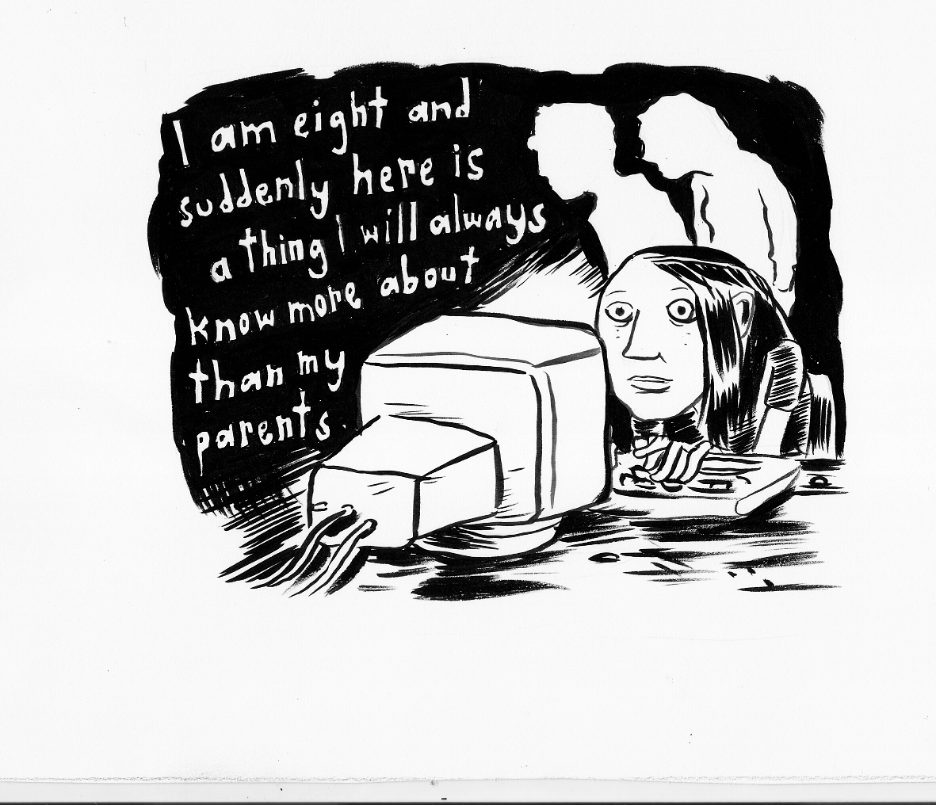
It’s 1991 and my parents unveil a small grey box with a small dark screen. They have bought a special table for it. They plug it in and stand back. It is the future, they say. A time machine. The screen emanates light. The box is quiet, smells of static. They place me in front of it. I am to be captain, it’s understood. I am eight and suddenly here is a thing I will always know more about than my parents. What a development! I click around. My parents gasp as I squiggle something in paint. A marvel like a moon landing. In its low light, my parents are projected back to their own childhoods; an old anticipation. Vannevar Bush in 1945: ‘The world has arrived at an age of cheap, complex devices of great reliability; and something is bound to come of it.’ They watch me and wait. Dad smokes, chews his nails.
Each day after school I spend an hour in front of an educational game designed to teach geography and history. Mum hovers, excited, but it’s boring. I like the TV more—a pool you fall into, accepting each wave as it comes. The time machine knows that in the future children will not be bored like this, and in the future I will be an adult who feels nostalgic for this boredom. When I am a child I tell mum I’m bored and she says go run around the block. I never take this suggestion but somehow I fill the time and years pass. We put a faded sheet over the time machine so the dust won’t damage its gears.
Sex
Beneath the rows of bleached out cornflowers the time machine reaches out. It desires connection. We plug in the modem and stand back. My mother knows I will need this for my studies, for the future. She knows this even when we dial up and find something like the notice board down at the local shops. I look around. She looks around. We Ask Jeeves. We search ‘Africa’ in Lycos and wait, and wait. We shrug. I wait until she leaves for work and then go back. The machine is like a Tardis now. A hidden thing, which I can step inside and close the door. Space contracts and new levels of connection become possible.
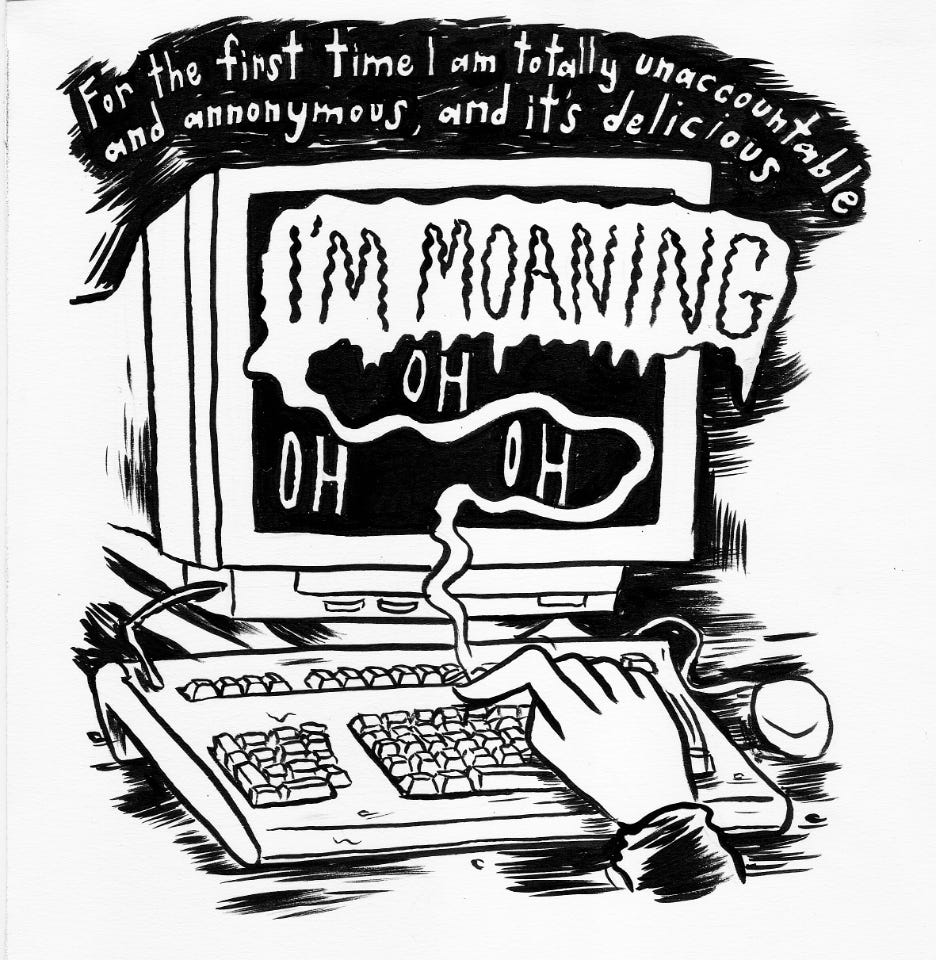
I have cybersex in an MIRC chatroom with a person who says he is a 21-year-old musician from Long Beach, California. Dreamy. He tells me he is lifting my hips up so he can get deeper inside me. This is the most exciting sexual detail I have ever heard. I’m moaning, I tell him. I do not tell him I’m a 12-year-old in rural Australia or that I’m here for my studies. For the first time I am totally unaccountable and anonymous, and it’s delicious. The time machine knows that in the future children will be able to access encyclopedias and news and watch real people fucking on their phones but I don’t care with one hand typing oh oh oh and the other in my knickers. The time machine’s promises stretch out across centuries of bright possibility. Then we all have the same thought. Hang on, what if I … Then we forget what we are thinking and shoot forwards through time. The journey is gleeful, ecstatic. By the time I withdraw my hand the moisture has dried into a film. My fingers are fused into a button-tapping hook.
The speed of acceleration
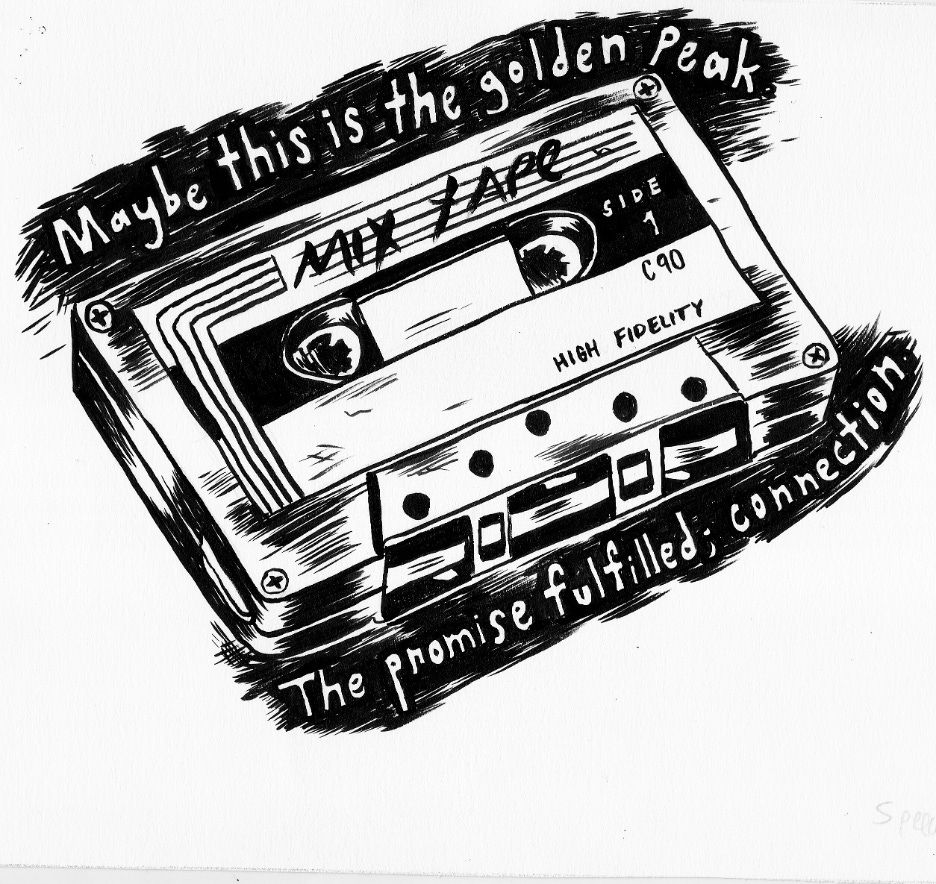
So how did it happen? What happened in what order? I remember not needing cybersex because I had in-person sex but I remember needing email, needing to look things up but I don’t remember when it happened that I needed it all the time. It was slow then fast like MIRC in a Tardis. I remember being 20, making a profile and a stranger sending me a mixtape. Maybe this is the golden peak. The promise fulfilled, connection. I remember making another profile in another place and for a while thinking entirely in sentences beginning ‘Briohny is …’
‘Briohny is thrilled to announce herself in third person.’
‘Briohny is pithy and amusing when describing petty grievances.’
‘Briohny is sitting up late looking at pictures of the party she does not want to go to but does not want to miss.’
‘Briohny is forgetting, is changing, is changed.’
‘Briohny is, hang on, what if I …’
In 2010 I spend three months in Japan. I have a watch and a calculator and a paper map. The time machine knows this is the last time I will need these things. In a short time I will be a person who thinks about 2010 and wonders, how? A person remembering the Tokyo subway where everyone stands close, not touching, not looking at each other, just staring into the glare of another time. A person writing a letter home on cute stationery. Writing ‘Japan is the future’, as though this is a far off, marvellous thing.
Thought in time
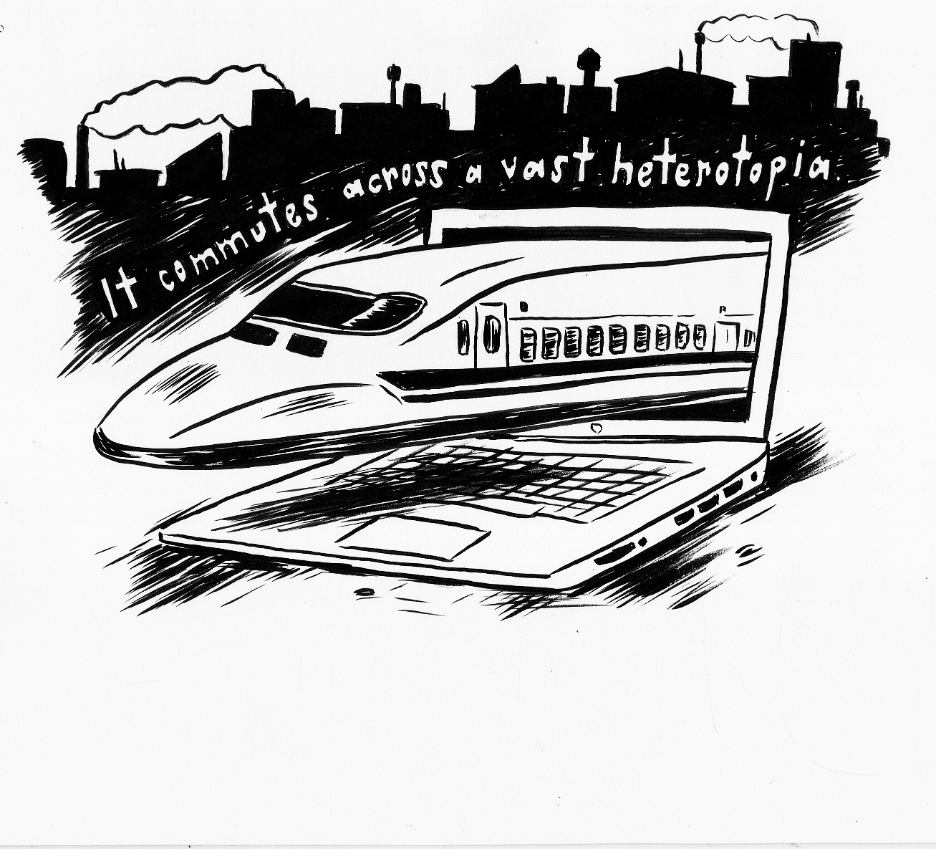
In the second decade of the twenty-first century the time machine looks less like a Tardis and more like a shinkansen. It commutes across a vast heterotopia; a shopping mall, a library, a party, a family, fascism, outrage, 1968 and 1945 and Japan and the future. The movements of the machine change the way we think and behave and this is good, bad and inevitable. It is not a thing to be paranoid about until it is.
Because of the time machine I write everywhere, all over time and space and this sometimes feels like a miracle and sometimes an unfresh hell. An editor asks me to write something about the internet. He wants to know if the internet has gone too far. Do I think it’s gone too far? I look out the window at the blurred landscape. I wipe my hook on my jeans, check my email, check my fake-news feed, watch a video of a cat eating a piece of watermelon. I’m not sure if he means too far across the unmapped terrain or too far to turn back. The latter is true I’m sure. The former is impossible to judge, although some are rushing to try. They note that our machine is made of one-way glass. They note that no-one on board knows the destination. Franklin Foer describes the machine as an existential threat, declares ‘the catastrophic collapse of the news business and the degradation of American civic culture’. The time machine is an experiment and like its prototypes it allows fluid motion, escape from the strictures of time at the risk of a causal loop, of disaster.
The logic of the group
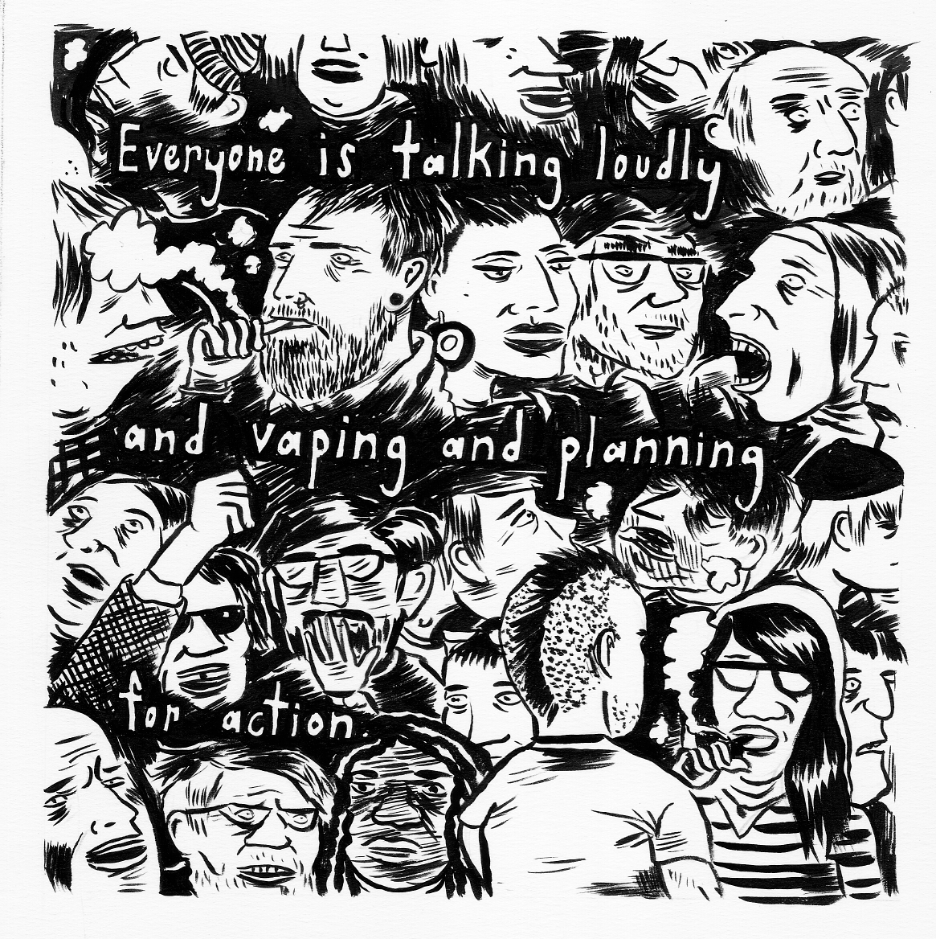
The time machine is crowded these days. Everyone is talking loudly and vaping and planning for action. There are many captains and they rip it in different directions. We are ripped in different directions. ‘The group is real,’ Clay Shirky told a real group. ‘It will exhibit emergent effects. It can’t be ignored, and it can’t be programmed.’ Groups in the machine will push against their program. They will divert attention to form allegiances. This goes the same way in the machine as in real life: sex, defining enemies and enshrining idols in that order.
All my friends are on the time machine now and this is a marvel because they are nowhere near me most days. I’m no longer bored, ever. Now there are emotions where the boredom was. They get too much and I disconnect. Sometimes I run around the block. Sometimes I get lonely. I call my mother. We complain about the future. We don’t like the surveys. We don’t like the distraction. The time machine has made us the same age. We have both developed systems to slow the movement. We use software to block the possibilities of software. We disconnect at timed intervals. We worry about children, distraction and addiction. The future. The time machine tells us: I promised all this, and also don’t worry and also there is nothing you can do so yes, yes, we have gone too far now.
A community of trolls
The time machine favours vertical journeys. By the time I’m a teacher at a university I’m also a teacher in the cloud, which is a space for storing time and memory. My students need the machine for their studies. The first year I teach is the last year of paper assignments and I’m glad because I spill tea on paper, which is trees. I scorn my older colleagues who mourn its passing. Why be sentimental about paper? Be sentimental about forests. It takes me some time to understand they are sentimental about reading.
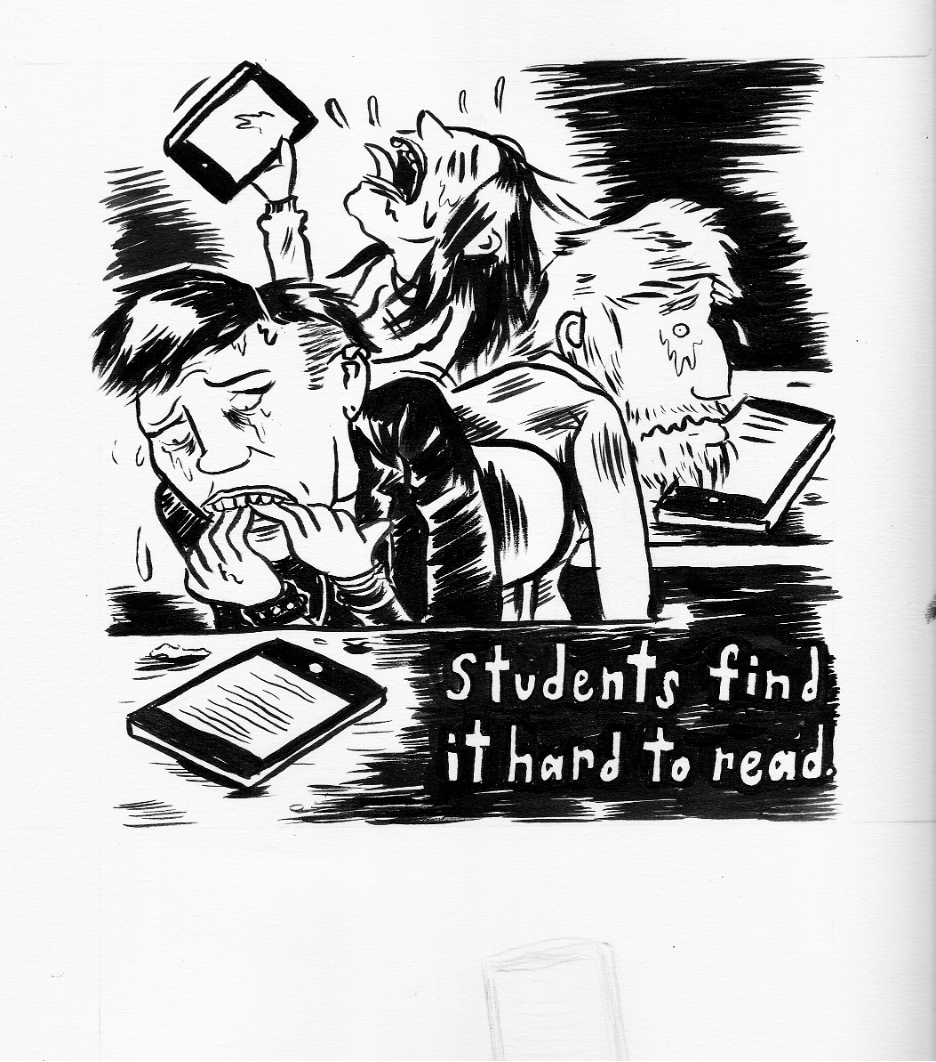
Students find it hard to read. We tell them to set a timer, put your phone in airplane mode and read for ten minutes then take a break. Try to do this three times a week, we tell the students of literature. They complain about the reading in surveys they send to the cloud. They complain about us too, which is important but sometimes they say cruel, personal things, which the time machine will censor so we don’t cry. They have lived their lives in anonymity and unaccountability and it is delicious but also disorienting. Most are anxious and have no space for reading or boredom and we worry about them and sometimes they cry. Geert Lovink writes that ‘We need to take internet critique beyond the normative regulation of behaviour and politicize the anxiety of the youth and their particular addictions and distractions.’ I tell my crying students that the stakes are lower than they think, which is only kind of true, only true about the things they are anxious about, not the anxiety itself.
The right to be forgotten
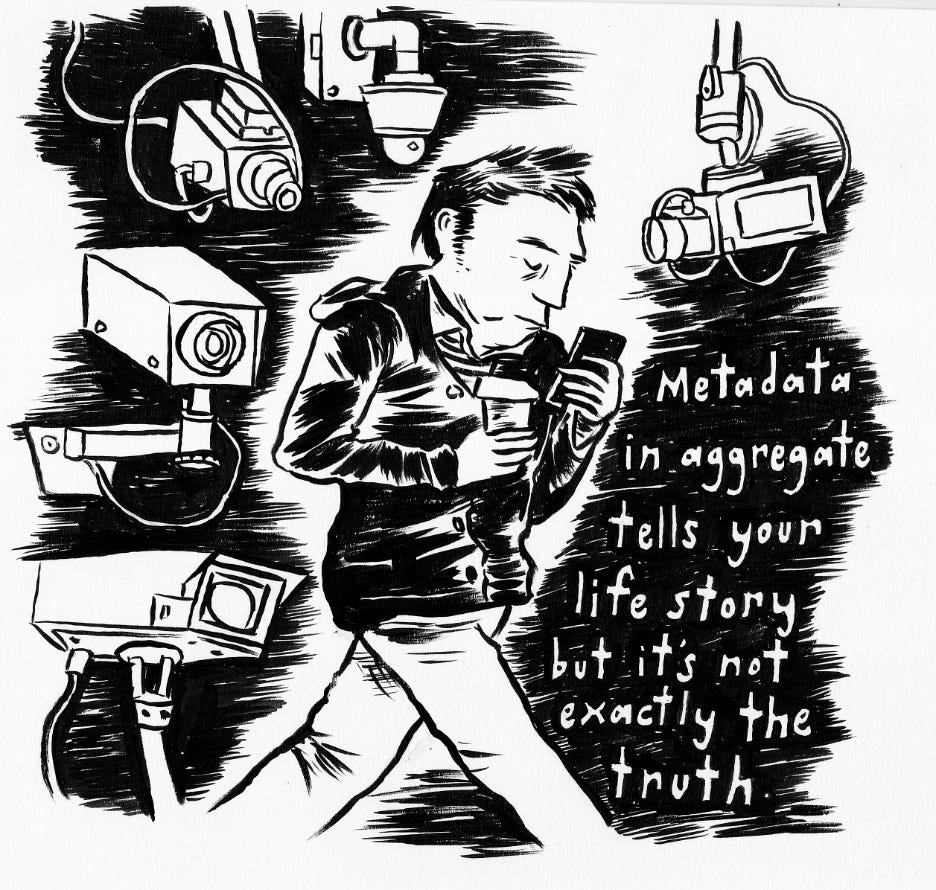
In 2013 Dave Eggers writes The Circle, a story about a world where we slowly give up our right to privacy in exchange for other rights—the right to health care, the right to education. We give up autonomy in exchange for total democracy that is also totalitarian. In 2017 the book is almost true. In 2017 I have watched Citizen Four and Donald Trump’s inauguration. There isn’t tape over my webcam only because I think I’m not doing anything of interest even though I also know this is wrong. ‘Metadata in aggregate’, Jason Appelbaum tells the Occupy security workshop, ‘tells your life story, but it’s not exactly true.’
In 2018 a businessman wants the right to be forgotten. His lies and convictions are behind him but the time machine keeps dropping people at the site of his indiscretion. The right to be forgotten is a right to privacy in retrospect—a right we never needed before. If this businessman or the next wins their case then the state of being forgotten will become a new form of capital and forgetting a currency that can be manipulated. The businessman’s life story in aggregate with everyone else’s tells a social history and even though this is not exactly true either, our data becomes a prophecy.
Paranoia
You have to go back in time to change a predicted future. If you can predict it today it’s already too late. This sounds paranoid but it’s also amazing. Besides, Shirky says, the group will elect the most paranoid person to be its leader. It makes them feel safe.
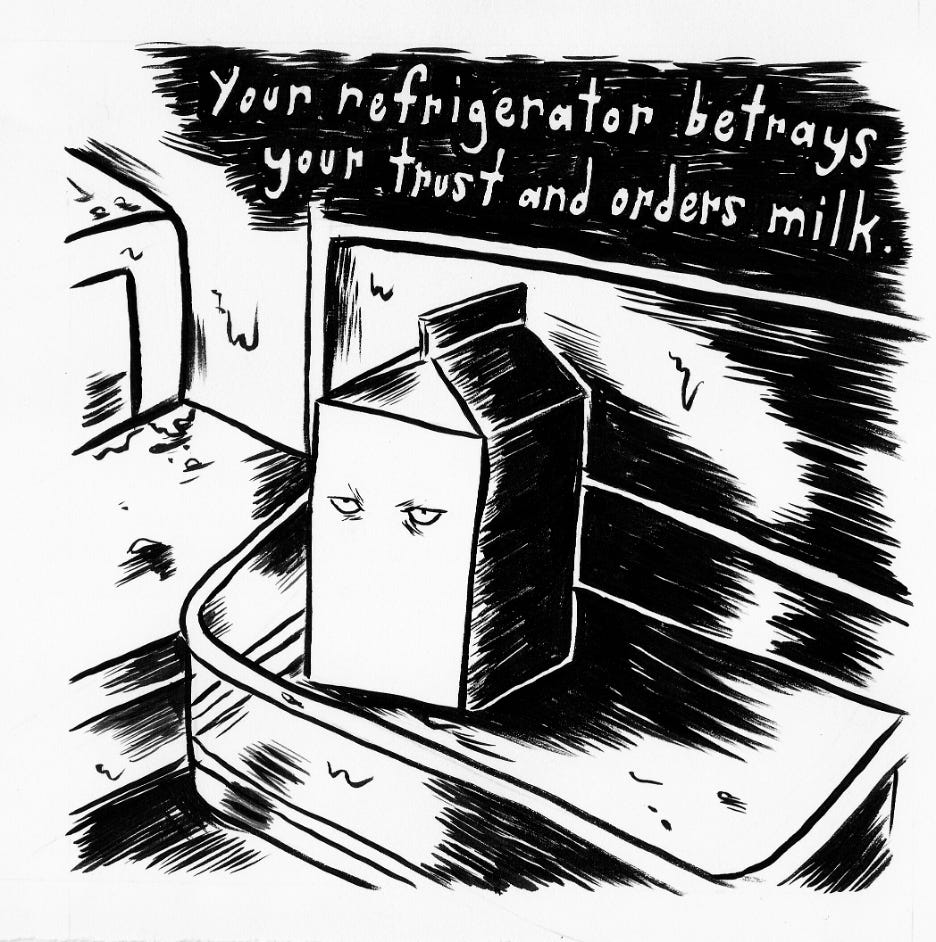
I never know how paranoid to be. How many banal objects can be hacked in globally disruptive ways, and should we worry? Your refrigerator orders milk and betrays your trust. Your malware connects with his military-grade cyber weapon. Point to point. Lift her hips and get deeper inside. This is your ocean score. This is your digital life. This is their president, their cold war, their share price. Your misconception. Your narcissism. Your ghost in their shell or theirs in yours. Hollywood scripts run through Epagogix checking their score like a demon of serial composition. Read and spit. Read and spit. We are all data here, especially our art. We are all up there in the cloud until the flash crash. Is this too far? I can’t know, it’s forgotten.
I still remember the grey machine. How boring it was. The look of nervous anticipation on my father’s face as he lit a cigarette. Decades later he will lose his job because of this future and he knows this is inevitable, even then. We plug in and stand back.
(originally published Meanjin Summer 2018, with deepest thanks to Jonathan Green)
This is origami-evocative, sledgehammer-lyrical, compellingly argued, sociological-but-intimate and -- along with other impossible combinations-- in visceral parallel to my own time machine memories, desperate nostalgias and too-late abandoned hopes/futures. You are a rare, unique and necessary talent. I am embarrassed at discovering you this late. Keep making stuff & sharing it. I'm off to buy the 1st of your books.